
How to Calculate Plant Values, Mutations, and Trade Profits in Grow a Garden Plant Value Calculator

You finally grow a rare plant, give it a valuable mutation, and then someone offers you a trade. The first question that comes to mind is simple: How much is this plant actually worth?
That answer is not always easy to figure out. In Grow a Garden Plant Value Calculator, a crop’s value can change based on its weight, rarity, mutations, boosts, and other factors. Two plants that look almost identical can end up having very different values.
This is where many players make mistakes. They rely on rough estimates, compare only the base value, or spend time doing the math manually. That can become frustrating, especially when you are checking several crops or deciding whether a trade is worth accepting.
The good news is that you do not have to guess. Once you understand how plant values and mutations work, you can make much smarter decisions. And when you need a quick calculation, a Grow a Garden calculator can help you check the numbers without doing all the math yourself.
In this guide, we will break down how crop values work, what affects them, how mutations and weight change the final value, and how you can use these calculations to make better decisions in the game.
What Affects a Grow a Garden Plant Value Calculator?
Plant value is one of the most important things to understand when you are trying to improve your garden.
Two players can have the same crop but get very different values because their plants may have different:
- Weight
- Rarity
- Mutations
- Quantity
- Boosts
- Other value modifiers
For example, a basic crop with a low weight may have a modest value. The same crop with a better weight and valuable mutations can be worth much more.
This makes it difficult to rely on the base crop value alone.
Instead, you should look at the complete combination of factors affecting the plant.
What Affects a Crop’s Value?
Several factors can influence the final value of a crop. Understanding each one helps you make better decisions.
1. Base Plant Value
Every crop starts with a base value.
Think of this as the starting point before additional modifiers are applied. Different crops have different base values depending on their type and rarity.
Knowing the base value is useful, but it is only the beginning of the calculation.
2. Plant Weight
Weight can have a major effect on the final value of a crop.
A heavier version of the same plant can be worth considerably more than a lighter one. This is why experienced players pay attention to crop weight instead of looking only at the plant name.
When checking a plant’s value, always enter its actual weight rather than using an estimated number.
3. Rarity
Rarity is another important part of the value calculation.
A rare crop may have a different value multiplier from a common crop. When several modifiers are involved, even a small difference in the calculation can change the final result.
4. Mutations
Mutations can dramatically increase the value of a plant.
Depending on the mutation, you may get a specific multiplier that changes the crop’s final value. Multiple mutations can also make the calculation harder because you need to account for how the modifiers work together.
This is where manual calculations can become confusing.
5. Boosts
Some situations can provide additional boosts.
For example, a friend boost can affect the final calculation. If you forget to include a boost, your estimated value may not match the result you actually expect.
6. Quantity
If you have multiple copies of the same crop, quantity also matters.
Instead of calculating each plant separately, you can calculate the value of one unit and then account for the total quantity.
How Do Grow a Garden Mutations Work?
Mutations are one of the most interesting parts of the game because they can change the value and characteristics of a crop.
Mutations may come from different sources, including random chances, special events, items, environmental conditions, or other game mechanics.
The important thing to remember is that not every mutation has the same effect.
Some mutations can provide a small increase, while others can create a much larger multiplier.
Can You Stack Mutations?
This depends on the specific mutations and the game’s current mechanics.
When multiple modifiers are involved, you should not simply guess the final value. You need to use the correct multipliers and stacking rules.
This becomes especially important when you are comparing two high-value plants or preparing for a trade.
The Easy Way to Calculate Plant Value
Doing every calculation manually is possible, but it can take time.
You first need to find the crop’s base value, check its rarity, enter the weight, identify its mutations, apply the correct multipliers, include any boosts, and then calculate the final result.
One small mistake can change the answer.
A calculator removes much of this unnecessary work.
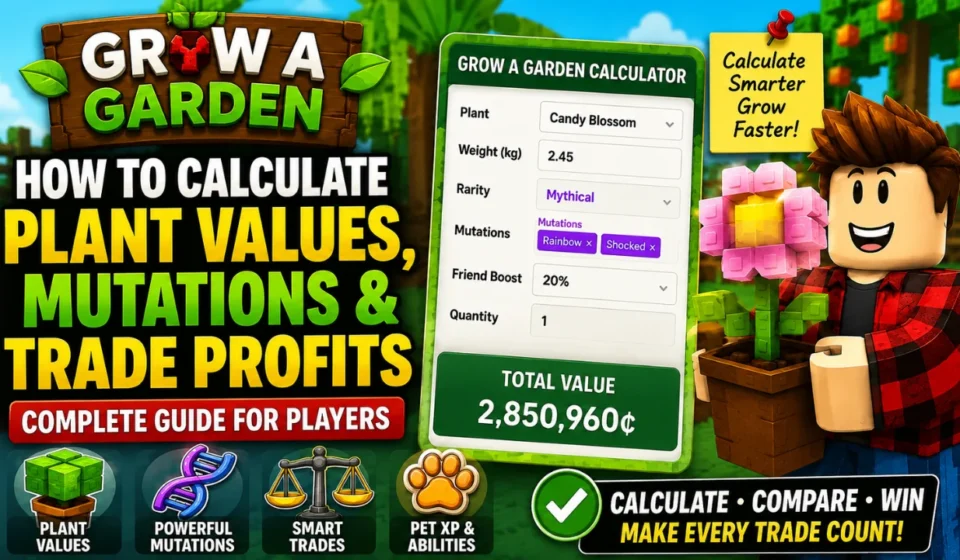
For example, Grow a Garden calculator tools can let you select a crop, enter its weight and quantity, add mutations and boosts, and see an estimated value.
The useful part is that you can see a breakdown instead of getting only one number.
That makes it easier to understand where the final value comes from.
How to Use a Grow a Garden Calculator
You do not need advanced math skills to use a calculator.
Follow these simple steps.
Step 1: Select Your Crop
Start by finding the crop you want to check.
Choose the correct plant from the available crop list or search for its name.
Choosing the right crop is important because every plant can have its own base value and rarity information.
Step 2: Enter the Weight
Next, enter the actual weight of your plant.
Do not use a random estimate if you already know the exact weight.
The more accurate your input, the more useful your estimated result will be.
Step 3: Add Mutations
Select all the mutations that apply to your crop.
If your plant has more than one mutation, make sure you include each relevant modifier.
This gives you a better idea of the combined effect on the final value.
Step 4: Add Boosts
If you have an applicable boost, include it in the calculation.
For example, a friend boost can be added when the tool supports that modifier.
Step 5: Check the Result
Once your information is entered, review the result.
A useful calculator should show more than just the final number. A breakdown can help you see the base value, weight multiplier, mutation multiplier, boosts, quantity, and other modifiers.
That makes it easier to spot an incorrect input.
Why Manual Calculations Can Be Difficult
Manual math sounds simple until you have several modifiers at the same time.
Imagine you are checking a crop with:
- A specific base value
- A particular rarity
- High weight
- Two mutations
- A friend boost
- Multiple copies
You now have several numbers to combine correctly.
The biggest problem is not the math itself. It is remembering which multiplier applies where and making sure you do not leave out a modifier.
A calculator is useful because it gives you a quick way to check your work.
You can still learn the mechanics, but you do not have to spend several minutes doing the same calculation every time.
How to Check if a Trade Is Worth It
Trading is another area where accurate values matter.
Before accepting a trade, compare the total value of what you are giving with the total value of what you are receiving.
Do not judge a trade only by looking at the number of items.
One rare or highly modified plant can be more valuable than several ordinary crops.
A simple trade calculation should include:
- The value of your items
- The value of the other player’s items
- Relevant mutations
- Weight differences
- Other applicable modifiers
- The total value on both sides
Once you have both totals, the comparison becomes much easier.
Why Weight Matters When Trading
Imagine two players are trading the same type of crop.
At first glance, the crops may look identical.
But one plant could have a much higher weight.
That difference can affect its value, so simply comparing crop names is not enough.
Before making an important trade, check the actual details of the items involved.
This is especially useful when dealing with valuable crops where a small difference can change the outcome.
Pet XP and Egg Hatch Calculations
Plant value is not the only calculation players may need.
If you spend a lot of time working with pets, you may also want to know how much XP a pet needs to reach a target level.
Egg hatch times can also be useful when planning your next steps.
Instead of keeping separate notes or trying to remember different numbers, dedicated tools can put these calculations in one place.
This saves time and makes planning your garden easier.
How to Make Better Garden Decisions
A calculator should not replace your understanding of the game. It should help you make better decisions with less unnecessary work.
Here are a few simple habits that can help:
Check Before Trading
If an item looks valuable, calculate it before accepting a trade.
Compare Different Mutations
Do not assume that every mutation has the same impact. Compare the actual multipliers.
Use Actual Weight
Always enter the real weight when possible.
Check Updates
Game mechanics can change after patches or events. Make sure the data you use matches the current game version.
Avoid Guessing
If you can calculate the value in a few seconds, there is little reason to rely on a rough estimate.
What Makes a Good Grow a Garden Calculator?
Not every calculator provides the same experience.
A useful tool should be:
Easy to use: You should not need a tutorial just to enter a crop.
Fast: Results should appear without unnecessary loading.
Mobile-friendly: Many players check values while playing on a phone.
Detailed: The tool should explain the result instead of showing a mystery number.
Updated: Game data and mechanics can change, so outdated information can lead to poor decisions.
Useful for more than one task: Plant values, mutations, pets, and trades are all connected to garden planning.
A Practical Tool for Faster Calculations
If you regularly calculate crop values or compare mutations, using a dedicated tool can save a lot of time.
The GrowCalc Grow a Garden calculator combines several useful calculations in one place. It includes plant value calculations as well as mutation, pet XP, egg hatch, pet ability, and trade profit tools.
The plant calculator lets you enter details such as crop, weight, quantity, mutations, and boosts. It then provides a value breakdown so you can see the factors behind the estimate.
That makes it useful for both quick checks and more detailed comparisons.
Final Thoughts
Grow a Garden becomes much easier to manage when you understand how crop values, weight, rarity, mutations, boosts, pets, and trades work together.
You do not need to calculate everything from scratch every time.
Start with the correct crop, enter its real weight, add the relevant mutations and boosts, and check the final result. If you are trading, compare both sides before making a decision.
Most importantly, use calculations as a way to understand the game rather than simply chasing the biggest number.
With the right information and a reliable Grow a Garden calculator, you can spend less time doing repetitive math and more time growing, collecting, trading, and planning your garden.



Comments are closed.
[…] enjoy games that involve careful planning and value calculations, you may also find our guide on Grow a Garden plant value calculator useful. It explains how plant weight, rarity, mutations, and other factors can affect crop values […]